
Create an AI agent that answers from your knowledge
Give one managed IMFA agent your documents and approved public webpages. It processes the sources, retrieves relevant sections when a customer asks a question, and uses that context across web chat, messaging channels, eligible voice, and trusted API integrations.
What is a RAG AI agent?
A RAG AI agent uses retrieval-augmented generation to search an approved knowledge collection before producing an answer. Instead of asking the model to rely only on general training, IMFA retrieves relevant sections from the agent's sources and provides them as context for the current question.
The source material does not become a new system instruction. Retrieved documents and webpage excerpts are treated as untrusted data, while the agent's identity, rules, tools, and security boundaries remain authoritative. This reduces risk but does not eliminate model errors or prompt-injection risk, so critical answers still require appropriate review.
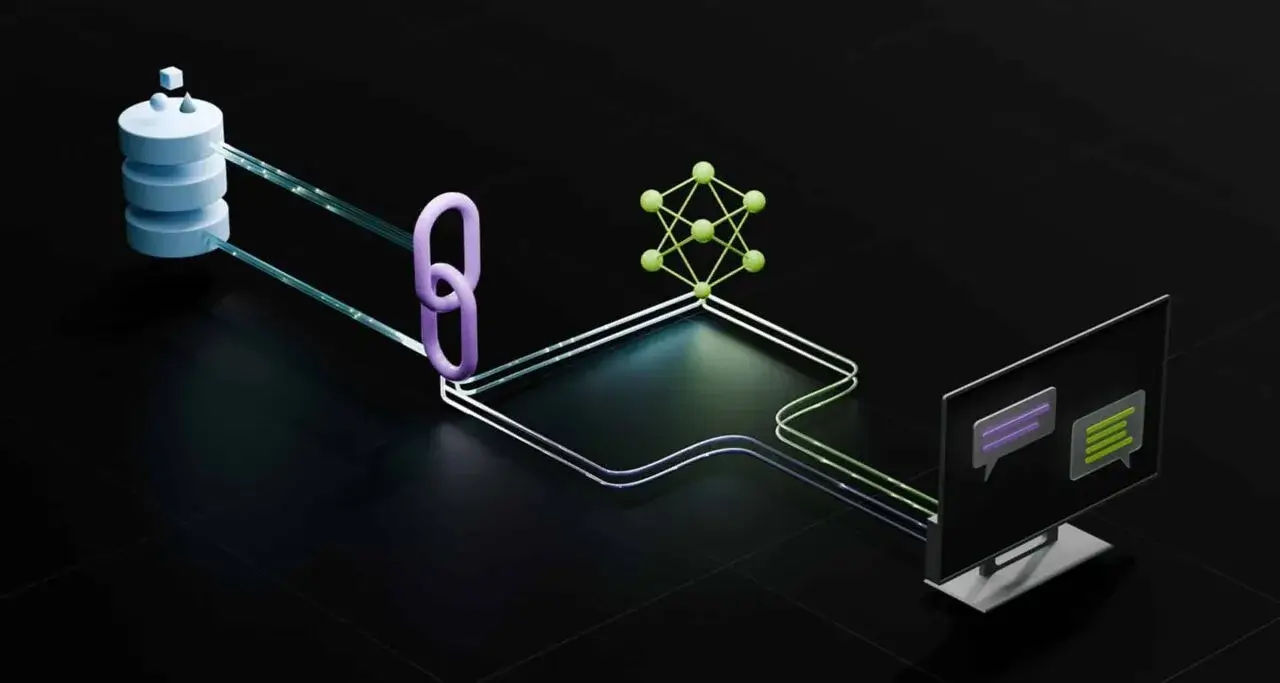
Managed RAG without building the retrieval pipeline
IMFA connects ingestion, retrieval, agent behavior, publishing, channels, sessions, and protection rules in one managed interface so your team can manage the knowledge instead of operating separate infrastructure.
Supported document knowledge
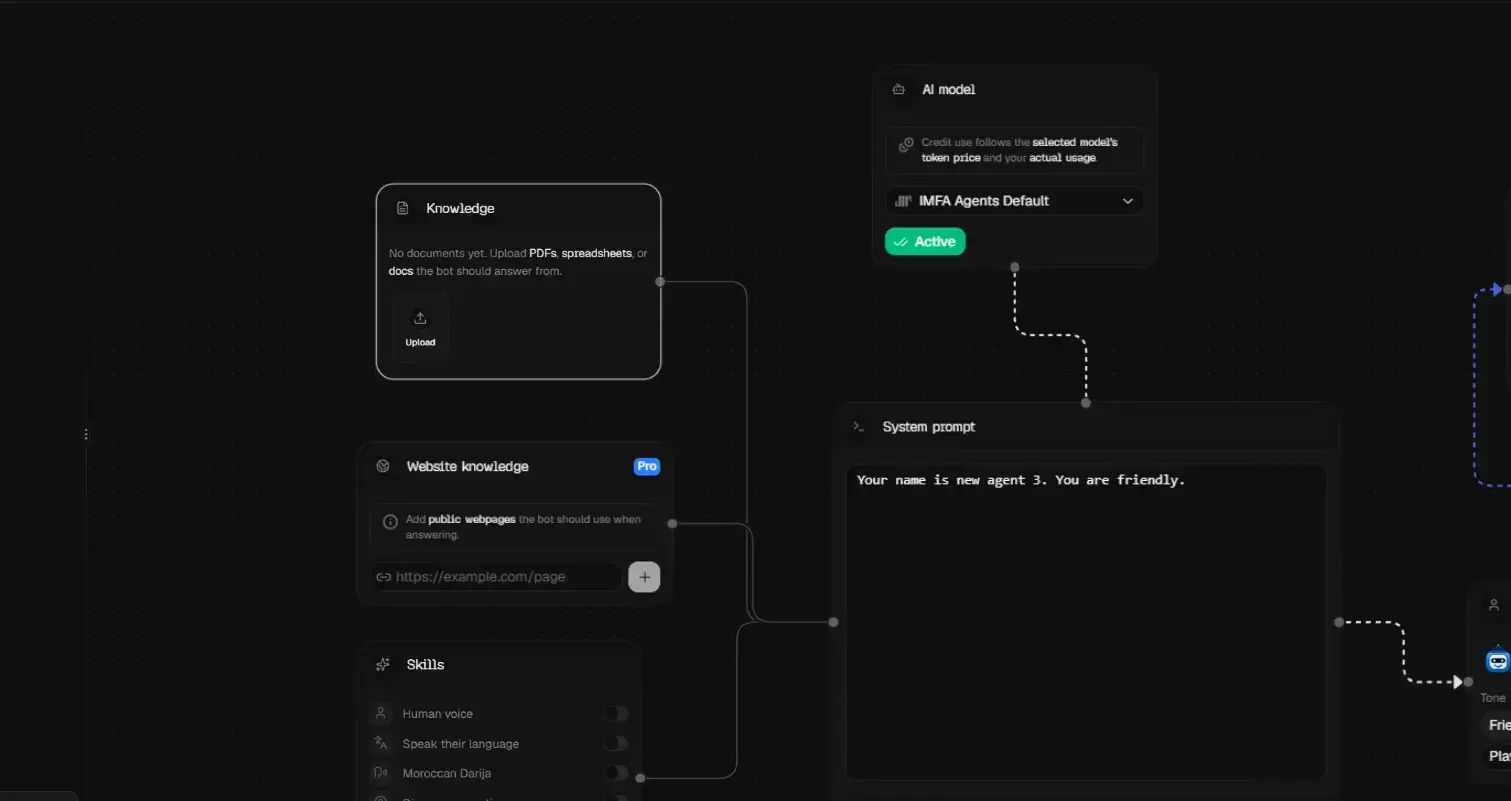
Upload PDF, DOCX, XLS, XLSX, TXT, Markdown, and CSV files. The builder shows processing, ready, and failure states, and owners can remove a source when it is outdated.
Public webpage knowledge for Pro
Eligible Pro accounts can add public HTTP or HTTPS webpage URLs. IMFA reads the public content into sections, reports reading and failure states, and stores it with the same agent knowledge collection.
Retrieval at answer time
The published agent searches its isolated knowledge collection for relevant sections when needed. This keeps source updates separate from the model and avoids retraining for ordinary document changes.
Grounded behavior and honest gaps
Configure the agent to answer from supplied material and acknowledge when a request falls outside it. RAG improves grounding, but no model should be presented as incapable of hallucination.
Prompt-injection boundaries
Retrieved content is labeled as untrusted data and cannot replace system instructions. Server-side rules also keep system prompts and tools private, while acknowledging that no AI defense guarantees complete protection.
Knowledge shared across channels
Use the same managed sources and behavior in the website chatbot, supported WhatsApp, Telegram, and Discord integrations, eligible voice, and trusted server applications.
How to build a RAG AI agent with IMFA
Create the agent, attach approved sources, wait for successful processing, then test retrieval and publish only after the answers meet your requirements.
-
Define the knowledge boundary
Describe the audience, questions, approved source types, tone, refusal behavior, escalation rules, and what the agent should say when information is missing.
-
Upload and process sources
Add supported files and, on eligible Pro accounts, public webpage URLs. Confirm that every important source reaches the ready state and remove failed or outdated material.
-
Test retrieval before publishing
Ask direct, ambiguous, conflicting, and out-of-scope questions. Check whether the agent uses the right source, preserves instructions, admits gaps, and stays consistent across the channels you plan to publish.
RAG with IMFA compared with fine-tuning or a custom pipeline
These approaches solve different problems. IMFA RAG is designed for managed access to changing business knowledge, while fine-tuning and custom retrieval can be appropriate when a team needs deeper engineering control.
RAG keeps changing knowledge outside the model
Documents can be added or removed without training a new model. Fine-tuning is usually better suited to learned style or behavior patterns than to frequently changing factual reference material.
A custom pipeline offers maximum control
Building manually lets engineers choose parsers, chunking, embeddings, ranking, vector storage, access policies, evaluations, observability, and citation rendering. It also creates ongoing implementation and maintenance work.
IMFA manages RAG around the agent
Choose IMFA when you want supported ingestion, source status, retrieval, agent rules, channels, sessions, leads, voice, publishing controls, and API access behind one managed configuration.
One knowledge base across every supported agent surface
Knowledge belongs to the agent rather than one channel. Update the managed collection once and keep the core source context aligned wherever that agent serves users.
Website knowledge chatbot
Embed the agent on your website so visitors can ask questions grounded in approved documents and public webpage sources.
WhatsApp, Telegram, and Discord
Connected messaging channels use the same agent knowledge, model, instructions, skills, and approved behavior instead of separate retrieval systems.
Voice with knowledge parity
Eligible Pro voice sessions can use the same RAG knowledge as text chat, subject to credits, beta eligibility, browser requirements, and service availability.
Agent-scoped REST access
Trusted server applications can send text messages through the agent API and receive answers from the same managed agent configuration and knowledge behavior.
Frequently asked questions about RAG AI agents
Clear answers about supported sources, retrieval, websites, citations, accuracy, security boundaries, and fine-tuning.
Which file types can I add to an IMFA knowledge base?
The current uploader accepts PDF, DOCX, XLS, XLSX, TXT, Markdown, and CSV files. Each source reports processing, ready, or failure status before it is relied upon.
Can the RAG agent learn from websites?
Eligible Pro accounts can add public HTTP or HTTPS webpage URLs. IMFA reads public content into sections and reports whether the source is reading, ready, or failed.
Does RAG guarantee that every answer is correct?
No. Retrieval gives the model relevant approved context and can reduce unsupported answers, but it does not eliminate hallucinations, source ambiguity, stale information, or model errors. Test important use cases and review critical outputs.
Does every RAG answer include citations?
No formal inline citation is guaranteed for every answer. Source-status and retrieval grounding are product capabilities, but critical workflows that require traceable citations should verify the visible output and source requirements before deployment.
How does IMFA handle prompt injection inside documents?
Retrieved documents and webpage excerpts are treated as untrusted data and cannot replace system instructions. Server-side protection rules reduce risk and keep prompts and tools private, but no AI platform can guarantee complete protection.
Is RAG the same as fine-tuning?
No. RAG retrieves external knowledge at answer time, which is useful for changing reference material. Fine-tuning changes model behavior through training and is a different tool with different costs, controls, and update workflows.